
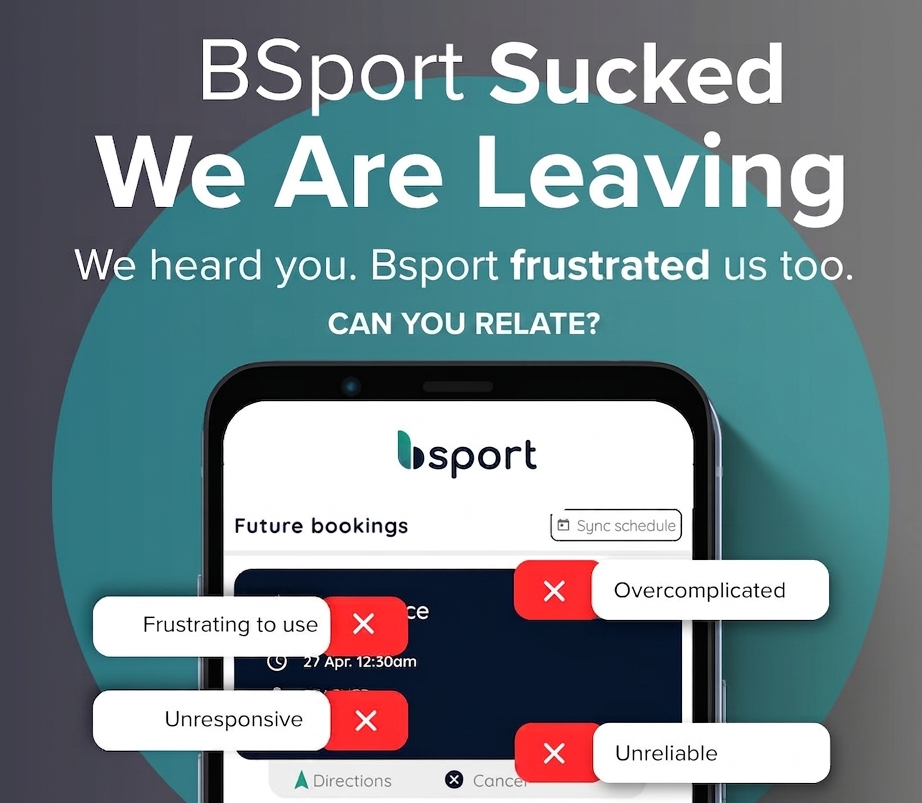
Why We Left Bsport – Our Experience After Seven Months on the Platform
Choosing a booking and business management platform is one of the most important decisions a studio owner will make. It affects every aspect of the business, from customer bookings and communication to payments, reporting and day-to-day administration.
In October 2025, Village Wellness migrated to Bsport because we believed it would improve the efficiency of our business. We carried out considerable due diligence before making that decision and expected the platform to streamline our operations, reduce administration and provide a reliable system for managing our growing business.
Our experience was the opposite.
Over the following seven months, we encountered a series of operational, technical and financial issues that fundamentally changed our view of the platform. Many of those issues are documented in months of email correspondence, support tickets, Zoom meetings, screenshots and a formal written complaint submitted to Bsport. Several were acknowledged by Bsport themselves, including migration limitations, onboarding oversights, billing errors and platform limitations.
This article is an account of that experience. It is not intended to criticise individuals within Bsport, many of whom genuinely tried to assist us. It is intended to help other studio owners make an informed decision before committing their business to the platform.
Our conclusion is straightforward.
Based on our documented experience, Bsport was not fit for purpose for our business, and we would not choose it again.
A migration that created problems rather than solving them
The difficulties began during migration and continued throughout our time on the platform.
Instead of moving seamlessly to a new system, we experienced issues with migrated customer data, including dormant or expired passes becoming active again, incorrect pass expiry dates and workshop bookings that did not migrate correctly. These issues required manual investigation and correction and created immediate confusion for both staff and customers.
In correspondence with us, Bsport acknowledged that certain platform limitations had not been identified during the sales process. While some migration issues were eventually addressed, they marked the beginning of a pattern that continued throughout our use of the platform.
Operational problems affecting day-to-day business
The most significant concern was not one individual fault but the number of essential business functions that repeatedly required support or intervention.
Customers experienced booking difficulties, including issues affecting Android devices that Bsport acknowledged required a software fix that didn’t happen. Clients contacted us because they were unable to complete bookings, and staff regularly had to assist with processes that should have been straightforward and self-service. Staff spent approx 5 hours extra per week admin time each week. Basic class reminders which is standard on all platforms, did not work for weeks after migration.
We also experienced repeated problems with notifications and customer communications. Notification settings became disabled, reminders required manual configuration by support and customer replies failed to appear reliably in the Bsport Inbox. At one stage we were advised to bypass the shared Inbox and redirect replies to my own email address instead. For a business relying on timely communication with clients, this was not an acceptable long-term solution.
Each individual issue required time to investigate, report, follow up and explain to customers. Collectively, they placed a significant administrative burden on the business.
Financial transparency and confidence
The financial management side of the platform became one of our greatest concerns.
Unlike a standard Stripe integration, we had no direct access to the Stripe dashboard. This meant we could not independently review transactions, reconcile payouts or examine payment processing information directly through Stripe.
Instead, we were required to rely on Bsport’s financial reporting. We repeatedly requested a detailed breakdown of payment processing fees but were never provided with a transparent itemised statement separating Stripe’s charges from Bsport’s own charges. During our correspondence, Bsport informed us that the detailed breakdown of those fees was proprietary information.
We also identified that VAT had been charged incorrectly. Bsport ultimately acknowledged the error, issued corrected invoices and refunded the VAT. Although that correction was welcome, it raised further questions about the accuracy and transparency of the financial reporting available to us.
Having no ability to process partial refunds was a serious drawback. We had no confidence in the financial transactions dashboard.
The cumulative impact on our business
Looking back, it is the cumulative effect of these issues that stands out.
No business expects a software migration to be entirely without problems. However, we did not expect months of continued operational issues, repeated support requests, ongoing investigations and manual workarounds affecting core aspects of our business.
We invested a considerable amount of time documenting issues, corresponding with support, attending Zoom meetings, testing proposed fixes and following up on matters that remained unresolved. We also incurred additional administrative costs dealing with problems created by the platform.
We will never know the full commercial impact of those seven months. We cannot quantify every lost opportunity or measure every occasion on which customers experienced unnecessary friction. What we do know is that the time spent dealing with platform issues diverted attention away from developing the business and supporting our clients.
We spend a significant amount of time on the migration and now we are faced with a migration to another platform which is a huge time cost again but we can not get away quick enough from Bsport before it damages our business further.
Outstanding issues at the time we left
Although some issues were eventually addressed, others remained unresolved or only partially resolved when we left the platform.
These included concerns regarding financial transparency, the absence of direct Stripe dashboard access, the lack of a transparent breakdown of payment processing fees, limitations affecting partial refunds, ongoing concerns regarding notifications and communication, and platform limitations that Bsport acknowledged but had not resolved.
It was against that background that our confidence in the platform was ultimately lost.
Our conclusion
We wanted Bsport to succeed because changing booking systems is expensive, disruptive and time-consuming. We invested significant time and effort trying to make the platform work for our business.
Ultimately, however, the platform delivered the opposite of what we had expected. Instead of simplifying our operations, it increased administration, created uncertainty and consumed valuable management time over a prolonged period.
Bsport ultimately agreed to release us from our contract following extensive correspondence and escalation they offered to waive fees for 3 months as compensation. We have considered suing them for adequate compensation but this is the problem for small studios coming up against a platform like this. They have a registered office in France and it is expensive to launch a legal challenge.
Every studio owner must make their own decision. We can only speak from our own experience.
Based on seven months of documented correspondence and day-to-day use of the platform, we cannot recommend Bsport to other studio owners. If reliability, transparency, efficient administration and confidence in your business systems are important to you, we believe you should examine all available alternatives and avoid Bsport under any circumstance.
Join our mailing list to be the first to hear when the next course dates are released.